Getting started with Spatial Validator 1.0
Next version — This documentation describes a major version that is not yet the current stable release of spatial-validator.
Spatial Validator 1.0 checks LongitudeOne spatial objects through Symfony Validator.
Use it to check a position, route or parcel boundary before accepting it in your application.
Creating an object with spatial-types establishes its structure; it does not establish its geometric validity.
Install
composer require longitude-one/spatial-validator:^1.0
Validate your first objects
After installing the package, validate an object with the generic Spatial constraint:
<?php

require 'vendor/autoload.php';

use LongitudeOne\SpatialTypes\Types\Dimension2\Geometry\Point;
use LongitudeOne\SpatialTypes\Types\Dimension2\Geometry\LineString;
use LongitudeOne\SpatialValidator\Validator\Constraints as SpatialAssert;
use Symfony\Component\Validator\Validation;

$pointA = new Point(5, -1);
$pointB = new Point(7, 3);
$pointC = new Point(3, 1);
$line = new LineString([$pointB, $pointC]);
$validator = Validation::createValidator();

$violationsPoints = $validator->validate($pointA, new SpatialAssert\Spatial());
echo count($violationsPoints); // 0

$violationsLines = $validator->validate($line, new SpatialAssert\Spatial());
echo count($violationsLines); // 0
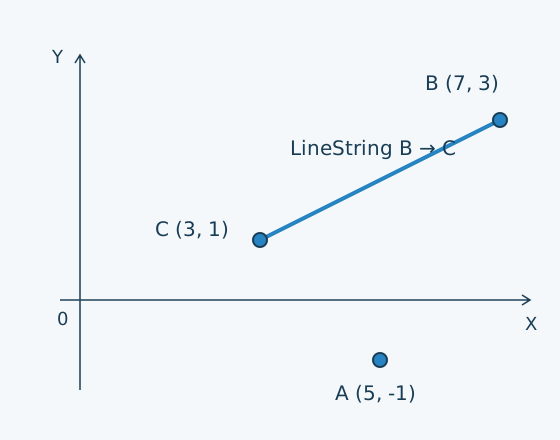
The example creates three points and a line connecting B to C, then validates point A and the line independently.
You do not need to choose a validator for each spatial type: the generic Spatial constraint automatically selects the appropriate validator
from the object's declared spatial type. The same constraint validates both the point and the line above.
Use a specialized constraint such as Point or Polygon only when your application also needs to require that particular type.
See geometry type validators for type-specific contracts and examples.
Use validation groups
Groups let your application select when a constraint runs, for example during an import.
Select the same group in the constraint and in Symfony's validate() call. Reuse $validator and $pointA from the example above:
$constraint = new SpatialAssert\Spatial(groups: ['Import']);
$violations = $validator->validate($pointA, $constraint, ['Import']);
echo count($violations); // 0
Delegation and component recursion preserve the active group, validation root and property path.
Spatial creates the specialized constraint with the selected groups, retaining the specialized defaults for diagnostic payloads.
Its own payload is not copied to every delegated diagnostic.
For custom metadata on a particular rule, apply that constraint explicitly and inspect the constraint associated with each violation.
Understand the result
Validation returns a Symfony violation list. Each diagnostic can identify a rule, a code and a path to the affected component. The list includes both errors and warnings, so a non-zero count does not by itself tell you whether to reject the object. Read diagnostics and warning payloads to define your application's policy.
Keep these boundaries in mind:
- Supported checks depend on the spatial type, coordinate dimension and Geometry or Geography family. An unavailable check produces a warning; it does not establish complete validity.
- Optional properties such as line simplicity and closure require explicit constraints.
nulland EMPTY spatial objects have different meanings. Use Symfony presence constraints when a value is required.- Validation inspects objects without repairing shapes, moving coordinates or converting their coordinate reference system.
Understand differences between a valid structure and a valid geometry
A valid structure contains the expected objects; a valid geometry also satisfies the rules of its declared spatial type. For example, three points A, B and C can form a valid open LineString, but they do not form a valid triangular boundary: the sequence must return to its starting point, A → B → C → A, to close it.
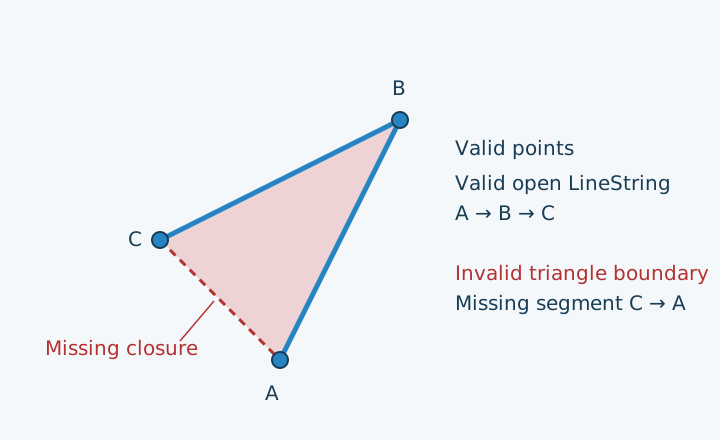
The red fill shows the intended triangle; the dashed closing segment is missing from the actual line.
See geometry type validators for the checks applied to each geometry type and concrete examples.
Choose your next step
| Your task | Read |
|---|---|
| Apply type-specific validation rules | Geometry type validators |
| Select when constraints run | Validation groups |
| Handle null, strings and presence checks | Input and EMPTY values |
| Check optional simplicity properties | Simplicity validators |
| Use collections without discarding EMPTY members | Collections |
| Read paths, codes and warning payloads | Diagnostics and composition |
Requirements and example verification
This documentation covers version 1.0. Examples use PHP 8.4 or later within PHP 8 and Symfony Validator 5.4, 6, 7 or 8.
The package requires spatial-core ^1.3 and spatial-types ^1.0@beta; Composer resolves these dependencies.
Download validation-examples.php to verify the documented contracts. In a project containing the package, run:
php validation-examples.php vendor/autoload.php
The script fails if an expected result changes and prints Spatial validation examples passed. on success.
It exercises generic and specialized constraints, groups, input handling, EMPTY members, curves, Polygon, Triangle and surface closure.