Diagnostics and validator composition
Next version — This documentation describes a major version that is not yet the current stable release of spatial-validator.
Each diagnostic identifies a failed rule or an unavailable check. Inspect its path, code and associated constraint to decide what the application should reject or present for review. Counting all Symfony violations treats warnings as failures unless your application deliberately distinguishes their severity.
From Symfony to elementary rules
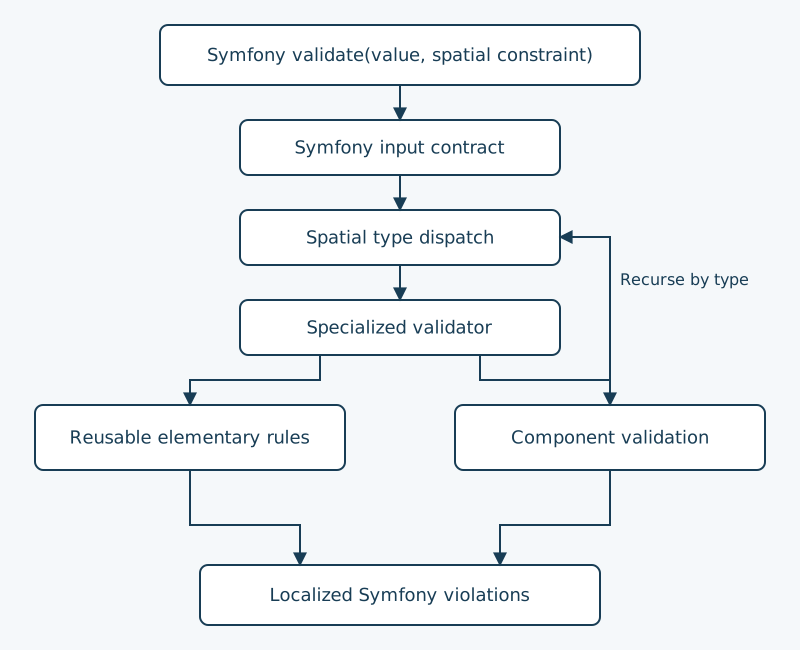
Symfony invokes the matching constraint-validator. After the input contract, Spatial dispatches by declared type to a specialized validator.
That validator composes reusable rules and recursively validates components through the same Symfony execution context.
Paths, root and active group survive delegation. A rule's original code and constraint remain associated with its violation.
Complete Polygon composition
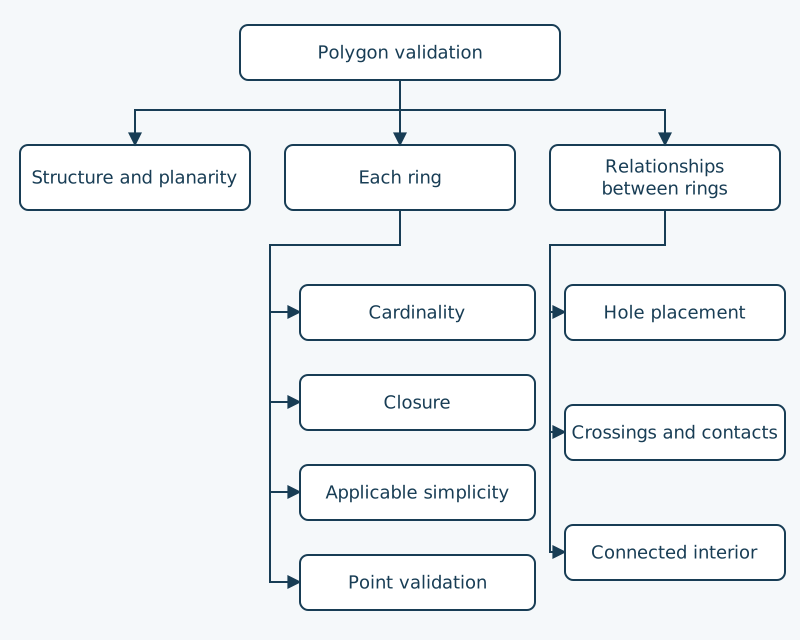
Structure and ring checks establish the prerequisites for dependent topology calculations. Errors in those prerequisites prevent unsafe calculations; their diagnostics are preserved. This internal composition does not expose a second structural-only public Polygon constraint.
Warning payloads
Warnings use the associated constraint's payload, normally ['severity' => 'warning'].
They remain in the Symfony violation list: count($violations) > 0 does not distinguish errors from warnings.
An unavailable Geography check establishes neither invalidity nor complete validity.
Hole orientation is another warning and does not imply that coordinates were repaired.
use LongitudeOne\SpatialTypes\Types\Dimension2\Geography\LineString;
use LongitudeOne\SpatialValidator\Validator\Constraints as SpatialAssert;
use Symfony\Component\Validator\Validation;

$line = new LineString([[0, 0], [1, 1]]);
$violations = Validation::createValidator()->validate($line, new SpatialAssert\SimpleLineString());
$errors = [];
$warnings = [];
foreach ($violations as $violation) {
    $payload = $violation->getConstraint()?->payload;
    $severity = is_array($payload) ? ($payload['severity'] ?? 'error') : 'error';
    if ('warning' === $severity) {
        $warnings[] = $violation;
    } else {
        $errors[] = $violation;
    }
}
echo count($errors); // 0
echo count($warnings); // 1: geodetic simplicity is unavailable
Payload is consumer metadata, not a Symfony filtering instruction.
Explicit payloads are preserved, including on cloned constraints used for warnings; overriding severity requires an application policy.
Generic Spatial does not overwrite specialized payload defaults with its parent payload.
Member diagnostics likewise retain their own constraint metadata rather than inheriting one uniform aggregate severity.
Paths and codes
Paths use zero-based member positions, appended to any enclosing Symfony property prefix.
For example, geometry.geometries[2].rings[1].points[3] locates the fourth Point of the second ring of the third collection member.
Topological errors can identify a ring or surface rather than a particular Point.
| Composition | Path segment | Example diagnostic |
|---|---|---|
| GeometryCollection | geometries[index] | components-cycle at a cyclic reference |
| LineString, CircularString, MultiPoint | points[index] | finitecoordinates-invalid |
| Polygon, Triangle | rings[index] | polygon-outside, triangle-position-count |
| MultiLineString | lineStrings[index] | simplemultilinestring-invalid |
| MultiPolygon | polygons[index] | multipolygon-intersection at the later member |
| CompoundCurve | curves[index] | compoundcurve-disconnected |
| PolyhedralSurface | patches[index] | polyhedralsurface-empty-patch |
A cyclic reference receives components-cycle; independent branches continue to be checked.
Shared objects in independent branches are not automatically cycles.
Compatibility errors use components-type, components-family, components-dimension or components-reference.
| Surface diagnostics | Codes |
|---|---|
| Polygon topology | polygon-intersection, polygon-outside, polygon-nested, polygon-disconnected |
| Polygon warnings | polygon-orientation, polygon-unavailable |
| Triangle shape | triangle-position-count, triangle-interior, triangle-distinct, triangle-topology |
| PolyhedralSurface | polyhedralsurface-dimension, -empty-patch, -incidence, -orientation, -connected, -intersection, -manifold |
| PolyhedralSurface warning | polyhedralsurface-unavailable |
| Explicit closed surface | closedpolyhedralsurface-invalid |
In abbreviated lists, each -suffix retains the preceding type prefix.
Shared structure errors retain their own codes, such as polygonstructure-degenerate for an absent supporting plane.
Optional rules use separate unavailable codes, such as simplelinestring-unavailable and firstpointequalslastpoint-unavailable.
Use stable codes for application branching; messages can be localized by Symfony's configured translator and should be presented as text.
For the outside-hole example in geometry type validators, inspect a diagnostic like this:
foreach ($violations as $violation) {
    printf("%s: %s\n", $violation->getPropertyPath(), $violation->getCode());
}
// rings[1]: polygon-outside
This last excerpt assumes $violations contains that Polygon result, not the Geography warning list above.
The executable examples also check a nested
geometries[0].rings[1] path with its original polygon-outside code.
Numerical comparisons
Finite coordinate equality uses this approved LongitudeOne comparison, separately for each spatial ordinate:
abs(a - b) <= PHP_FLOAT_EPSILON * max(1.0, abs(a), abs(b))
It includes Z when present and ignores M. Thus two XYM positions that differ only in M are spatially equal. This is a floating-point comparison policy, not a configurable business distance tolerance or a general topology predicate. Orientation, intersection, planarity, arc and volume calculations use robust intermediate predicates adapted to their quantities; the delivered Geometry algorithms use exact rational/algebraic signs over the supplied finite binary coordinates.
No determinant threshold is obtained by blindly reusing the coordinate epsilon. There is no extra proximity tolerance, snapping, rounding, merging or coordinate movement. Nearby disjoint shapes do not become touching merely because the gap is small. Approximate endpoint equality does not excuse a real interior crossing or replace the original coordinates.